
Home >> Our Blogs >>Google Ads vs Meta Ads: Where Should Your Business Spend Its Budget First?
Introduction
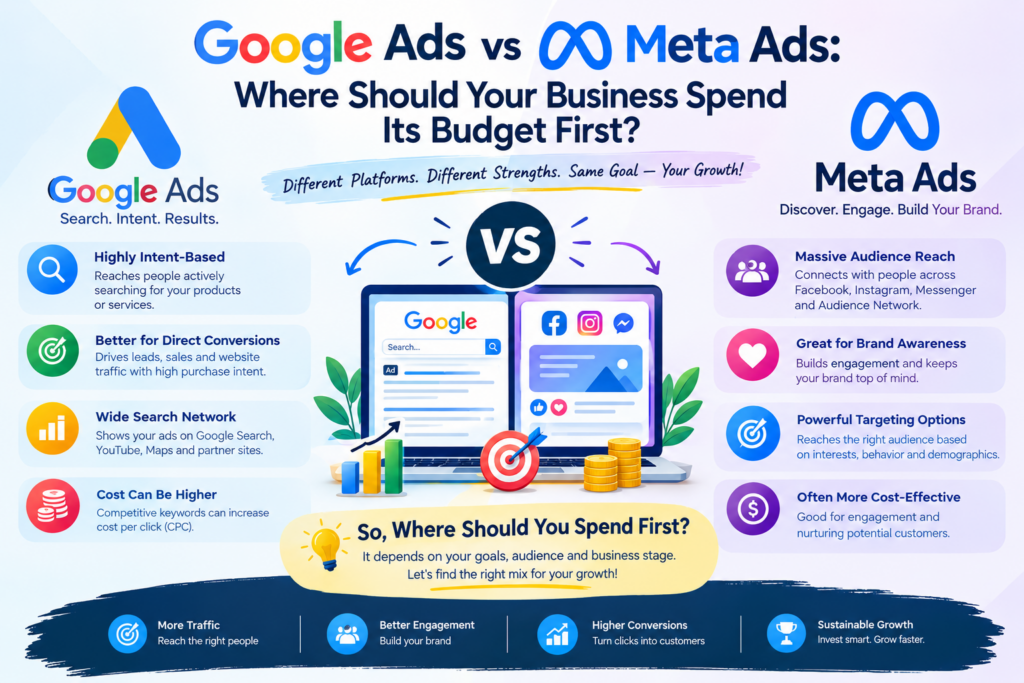
Almost every business that decides to try paid advertising ends up asking the same question: should the first rupee go to Google or to Meta? Both platforms can deliver enquiries and sales. Both can also burn through a budget quickly when used in the wrong situation. The honest answer is that neither is better in general. Each one is better for a particular job, and the right first choice depends on what you sell, who buys it, and how those people behave before they buy.
This guide compares Google Ads and Meta Ads (Facebook, Instagram, Messenger and WhatsApp placements) in plain language, shows where each tends to perform best, and gives a practical way to decide where to spend first, how to split a limited budget, and how to test fairly before committing more.
The Core Difference: Demand Capture vs Demand Creation
The simplest way to understand the two platforms is through the mindset of the person seeing the ad.
Google Ads reaches people who are actively searching. Someone types "emergency plumber near me" or "best CRM for small teams" and your ad appears at that moment. The need already exists; your job is to be the answer. This is often described as capturing existing demand.
Meta Ads reaches people who are scrolling. Someone is catching up with friends or watching short videos when your ad appears. They were not looking for you, but the right message, image, or offer can spark interest they did not know they had. This is closer to creating demand.
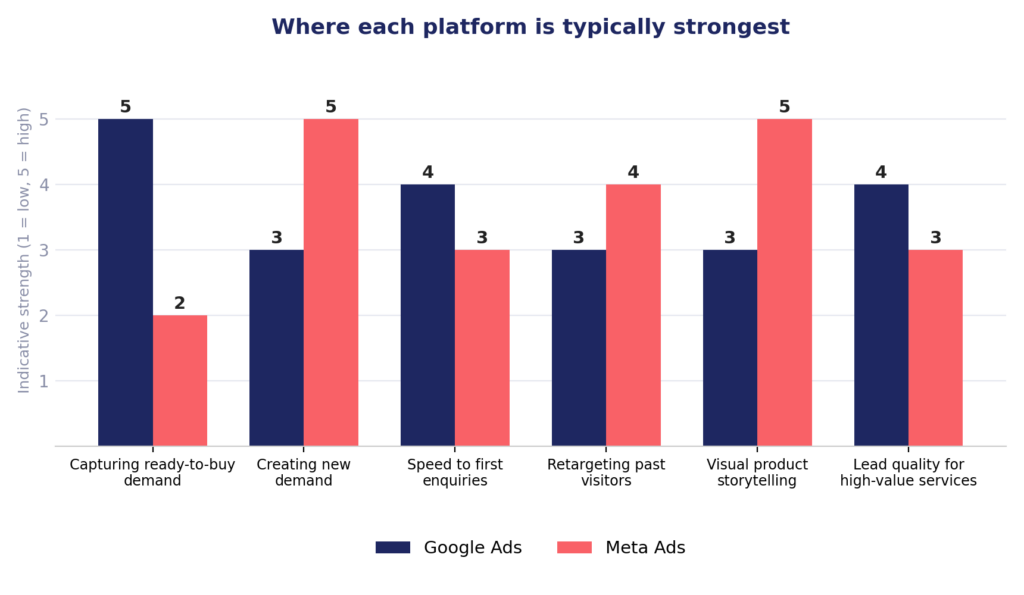
That one difference explains most of what follows: why Google often produces faster, higher-intent enquiries for services, why Meta shines for visual products and new brands, and why many businesses end up using both in different roles.
Google Ads vs Meta Ads at a Glance
Factor | Google Ads | Meta Ads |
Audience mindset | Actively searching for a solution | Browsing, entertained, not yet looking |
Main strength | Capturing ready-to-buy demand | Building awareness and sparking interest |
Targeting based on | Keywords, search intent, location, audience signals | Demographics, interests, behaviors, custom and lookalike audiences |
Common formats | Search, Shopping, Display, YouTube, Performance Max | Image, video, Reels, Stories, carousel, lead forms, click-to-message |
Creative effort | Mostly text for search; more for video and display | High: needs strong visuals and fresh creative regularly |
Time to first enquiries | Often quick, because intent is high | Quick to launch; may need more testing to find winning creative |
Best at retargeting | Good, especially for past site visitors | Very good, with video viewers, engagers and site visitors |
Typical sweet spot | Services, high-intent products, local businesses | Visual products, lifestyle brands, launches, community building |
When Google Ads Is the Smarter First Move
Google tends to be the better starting point when people already search for what you sell. That includes most local and service businesses, professional firms, B2B suppliers, repair and emergency services, clinics, training providers, and products with a clear search term attached to them.
- Your customers solve a problem and look for a provider, so being visible at that moment matters most
- Your service has a high value per customer, so even a modest number of high-intent enquiries is worthwhile
- You want measurable leads quickly while organic rankings are still developing
In our own campaigns, this shows up clearly. A Canadian immigration firm generated over 570 qualified leads in six months through Google Ads, and another Canadian legal practice generated 540+ leads at an 8.62% click-through rate and an average cost per lead of CA$25. These are results from specific accounts and not promises, but they show what intent-based search can do when the account is structured and tracked properly.
If you are new to the platform, our PPC overview explains how campaigns are built, and the PPC packages page outlines how ongoing management is typically structured.
When Meta Ads Is the Smarter First Move
Meta tends to win when people do not yet know they want what you sell, or when the product sells itself through how it looks.
- Visual or lifestyle products such as fashion, jewellery, home decor, food, beauty and gifting
- New brands or launches that need awareness before anyone will search for them by name
- Offers that suit impulse or emotional decisions, such as events, courses, classes or promotions
- Businesses whose customers prefer to message first, where click-to-WhatsApp or Messenger ads shorten the path to a conversation
Meta also works hand in hand with organic social. Strong posts and Reels give paid campaigns better creative to promote, which is why a consistent social media marketing presence usually improves paid results rather than competing with them.
A Simple Decision Guide by Business Type
Your situation | Spend first on | Why |
Urgent local service (clinic, repair, legal) | Google Ads | Customers search the moment they need help |
B2B or professional services | Google Ads, with Meta for retargeting | Buyers research by search; Meta keeps you visible afterwards |
Established online store | Both, roughly balanced | Google captures buyers; Meta reaches new and returning shoppers |
Education and coaching | Both, tested side by side | Some students search, others respond to stories and proof |
Visual D2C, fashion or lifestyle | Meta Ads first | Strong visuals drive discovery before anyone searches |
New brand or product launch | Meta Ads first, add Google as demand grows | Nobody searches for a brand they have not heard of yet |
How to Split a Limited Budget
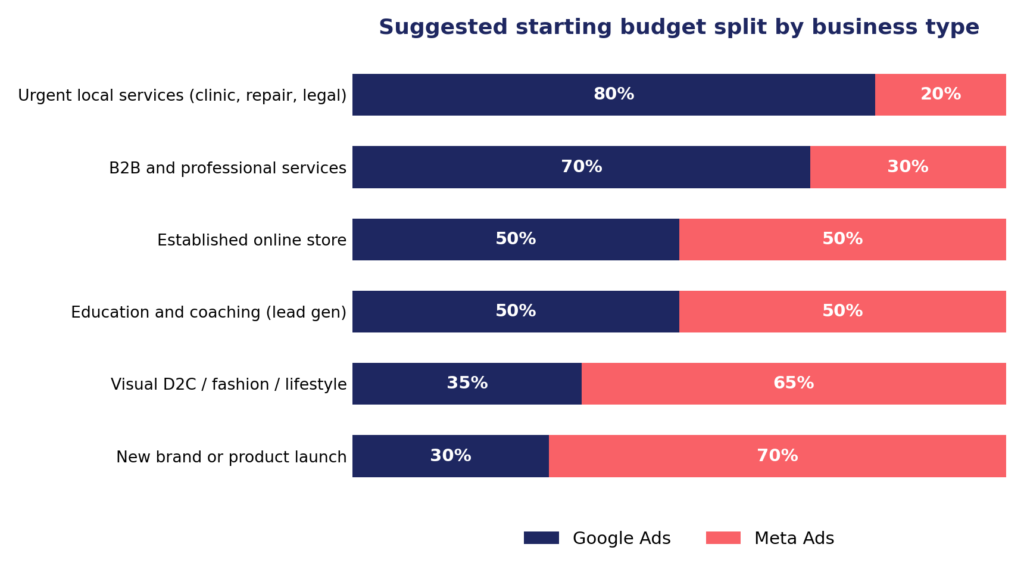
If you can only afford to start in one place, pick the platform that matches your situation in the table above and give it enough budget to gather real data. Splitting a small budget across both platforms and several campaigns often leaves each one too thin to learn anything. If you can fund both, a sensible starting split depends on your business type, as shown below.
Treat these splits as a first hypothesis. After a few weeks of data, move money toward whichever platform delivers qualified leads or sales at a cost you can sustain, and keep a smaller share running on the other to keep learning.
Use Both: How the Platforms Work Together
The strongest accounts rarely treat this as a choice. They treat Google and Meta as different stages of the same journey. Meta introduces the brand to people who were not searching. Some of those people later search for the brand or the solution on Google, where a well-built search campaign catches them. Retargeting on both platforms then brings back visitors who did not convert the first time.
Paid and organic search support each other as well. Paid campaigns show which keywords and messages actually produce enquiries, and that insight can shape the content plan behind your SEO work, while strong organic rankings reduce how much you need to pay for the same clicks over time.
Fix These Before You Spend a Rupee
Many campaigns fail for reasons that have nothing to do with the platform. Before launching on either one, check the basics:
- Conversion tracking is working, so you know which clicks produce leads or sales
- Every ad leads to a relevant landing page, not just the homepage
- The page loads quickly on mobile and the next step is obvious
- There is a clear process for answering enquiries fast, since slow replies waste paid leads
The landing page is the most overlooked piece. A good ad sending traffic to a confusing page wastes most of the click, which is why it is worth reviewing the common UI/UX mistakes that hurt conversions and making sure your website development foundations are sound. If you sell online, solid ecommerce development matters just as much, since checkout friction cancels out good ad performance.
How to Compare the Two Fairly
It is tempting to compare click-through rates or cost per click between platforms, but these numbers are not like-for-like. A click from a search ad and a click from a feed ad come from people in very different moments. Instead, compare what the business actually cares about:
- Cost per qualified lead, not just cost per lead, since lead quality can differ sharply between platforms
- Cost per sale and return on ad spend for online stores
- The share of leads that become paying customers, tracked from enquiry through to close
Results over a long enough window, because Meta in particular needs time to learn and rotate creative
A 60-Day Test Plan
Period | What to Do |
Week 1 | Set up conversion tracking, landing pages and one clear offer. Define what counts as a qualified lead |
Weeks 2-3 | Launch one focused campaign on your first-choice platform with a small number of tightly themed ad groups or audiences. Resist changing things daily |
Weeks 4-5 | Review cost per qualified lead. Refresh weak creative or keywords. Add retargeting if you have enough traffic |
Weeks 6-8 | Start a smaller test on the second platform. Compare results on the same definition of a qualified lead and decide where to shift budget |
Common Mistakes to Avoid
- Choosing a platform because a competitor or a friend uses it, rather than based on how your customers buy
- Judging Meta by search-style conversion expectations, or Google by awareness-style expectations
- Spreading a small budget across too many campaigns to learn anything
- Changing campaigns every day instead of letting them gather data
- Running ads with no conversion tracking, then guessing what worked
- Sending all traffic to the homepage instead of a page built for the ad's offer
Frequently Asked Questions
Which is cheaper, Google Ads or Meta Ads?
It depends on your industry, competition and location. Costs per click vary widely on both platforms, and a cheaper click is not better if it produces fewer qualified leads. Compare cost per qualified lead or cost per sale instead.
How much budget do I need to start?
Enough to collect meaningful data over several weeks. A budget so small that it produces only a handful of clicks makes optimization nearly impossible, so it is usually better to run one focused campaign properly than several thinly.
Can a new business start with Meta Ads only?
Yes, especially if the product is visual or new to the market. Just make sure there is a clear offer and tracking in place, and consider adding Google search once people begin to look for your brand or category.
Should I stop one platform if it underperforms?
Not immediately. First check tracking, landing page, offer and creative, since these cause most poor results. If performance stays weak after a fair test, move budget to the stronger platform and keep a small test running.
Do paid ads replace SEO?
No. Ads deliver visibility while you pay for them; SEO builds visibility that continues to bring traffic without a cost per click. Most businesses benefit from both.
Getting Started
Choosing where to spend first is easier with an honest look at your customers, margins and current website. ARP SOFTTECH helps businesses plan and run paid campaigns alongside search and social, and you can compare PPC packages, browse more strategy guides on the blog, read about the team on the About Us page, or get in touch to discuss which platform should come first for your business
Conclusion
Google Ads and Meta Ads are not rivals so much as different tools. Google is strongest when people are already searching for what you offer, and Meta is strongest when you need to introduce your business to people who are not. Start with the platform that matches how your customers actually buy, give it enough budget and time to produce real data, set up tracking and landing pages properly, and then let the numbers show you where the next rupee should go.