
Home >> Our Blogs >>WordPress vs Shopify vs Custom Development: Which Platform Is Right for You?
Introduction
Choosing a website platform is one of those decisions that feels small in the moment and expensive to undo later. Pick the wrong one, and a business might find itself migrating an entire catalog, rebuilding integrations, and losing search rankings a year or two down the line — all because the platform that seemed easiest at launch couldn't keep up with how the business actually grew.
WordPress, Shopify, and fully custom development are the three paths most businesses end up weighing, and each one genuinely excels in different situations. This guide breaks down what each option actually is, where it shines, where it falls short, and how to think through the decision based on the business's real priorities rather than whichever platform happens to be trending in a given year.
A Quick Overview of the Three Options
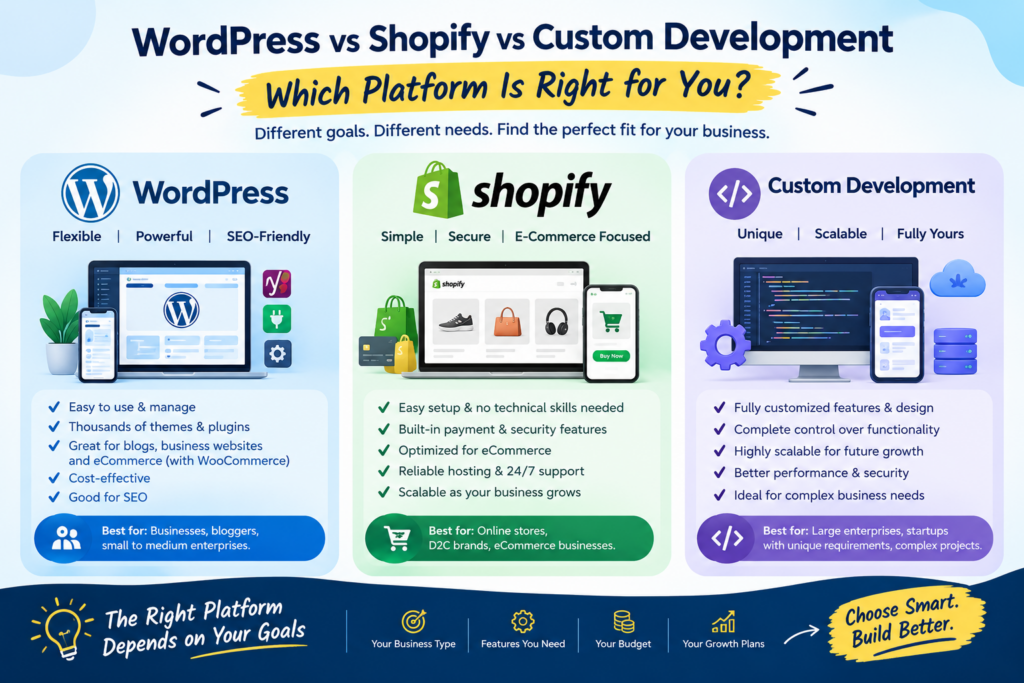
WordPress
An open-source content management system powering a significant share of all websites on the internet. With the WooCommerce plugin added, it becomes a capable ecommerce platform too. Its biggest strength is flexibility — thousands of themes and plugins exist for nearly any feature imaginable.
Shopify
A fully hosted, ecommerce-first platform built specifically for selling products online. Everything — hosting, security, payment processing, inventory — is bundled together, trading some flexibility for a dramatically simpler setup and maintenance experience.
Custom Development
A website or application built from the ground up, tailored precisely to a business's specific workflows, without being constrained by a pre-built platform's assumptions about how things should work. This offers the most control and the highest upfront investment of the three.
Side-by-Side Comparison
Factor | WordPress | Shopify | Custom Development |
Upfront Cost | Low–Medium | Low–Medium | Medium–High |
Time to Launch | Fast | Fastest | Slowest |
Ongoing Maintenance | Moderate (updates, security) | Minimal (hosted & managed) | Depends on build quality |
Design Flexibility | High | Moderate | Unlimited |
Ecommerce Features | Good, via plugins | Excellent, built-in | Fully custom, as needed |
SEO Flexibility | Excellent | Good, some limitations | Excellent, fully controlled |
Scalability | Good, with proper setup | Good, within platform limits | Highest, built for specific scale |
Best For | Content-heavy sites, blogs, small-to-mid stores | Dedicated online stores wanting simplicity | Complex, unique, or high-scale requirements |
WordPress: Flexible, Familiar, and Endlessly Extendable
Where it excels
WordPress's enormous plugin ecosystem means almost any feature — booking systems, membership areas, multilingual content, advanced forms — already has an existing plugin rather than requiring custom code. Its content tools are genuinely excellent, making it a natural fit for businesses that publish regularly and care about organic search visibility, since full control over on-page SEO elements is built in rather than restricted.
Where it struggles
That same flexibility is also its biggest risk. A WordPress site stitched together from a dozen plugins from different developers can become slow, insecure, or fragile if not properly maintained. Updates need to be managed carefully, since a plugin conflict after an update is a common cause of unexpected downtime. It requires more hands-on technical care than a fully hosted platform.
Best suited for
Content-driven businesses, blogs, service businesses, and small-to-mid-sized stores that want strong SEO control and design flexibility without committing to a fully custom build
Shopify: Simplicity Built Specifically for Selling
Where it excels
Shopify removes nearly all the technical overhead of running an online store — hosting, security patches, PCI compliance for payments, and uptime are all handled automatically. Launching a functional store can happen in days rather than weeks, and its app ecosystem covers most common ecommerce needs without touching code.
Where it struggles
That simplicity comes with boundaries. Highly specific workflows outside what Shopify or its apps support can be difficult or expensive to implement. Monthly subscription costs plus transaction fees and paid apps can add up as a store scales, and businesses with very particular design or functionality needs sometimes find themselves working around the platform rather than with it.
Best suited for
Businesses whose primary goal is selling products online, who value speed to launch and low technical maintenance over deep customization.
Custom Development: Maximum Control, Maximum Investment
Where it excels
A custom-built site or application has no inherited limitations — every feature, workflow, and integration is built specifically for how the business actually operates, not adapted from a generic template. This matters most for businesses with unusual processes, high transaction volumes, complex integrations with internal systems, or ambitions that a pre-built platform simply can't accommodate as they scale.
Where it struggles
All of that control comes at a cost — higher upfront investment, longer development timelines, and an ongoing dependency on skilled developers for maintenance and updates, since there's no large community-built plugin library to lean on. It's rarely the right starting point for a business still validating its core business model.
Best suited for
Established businesses with specific, proven requirements that off-the-shelf platforms can't satisfy, or ambitious projects where the website or application is itself the core product.
A Middle Ground Most Guides Skip
The choice isn't always strictly one or the other. WooCommerce on WordPress offers a genuine middle ground — more ecommerce-specific structure than plain WordPress, more flexibility than Shopify, without the full cost of custom development. Similarly, "headless" approaches — using Shopify or a custom backend purely for commerce logic while building a fully custom front-end experience — are increasingly common for businesses that want Shopify's reliable backend with design freedom Shopify's own themes don't offer.
A Simple Decision Framework
- If content and SEO are the priority, and ecommerce is secondary or absent — WordPress is usually the strongest fit
- If selling products online is the entire point, and speed to launch with low maintenance matters most — Shopify is usually the easiest path
- If the business has specific, proven workflows no platform quite supports, or plans to scale well beyond what off-the-shelf tools handle comfortably — custom development earns its higher cost
- If budget is tight and requirements are still evolving, starting on WordPress or Shopify and migrating later is often smarter than overbuilding too early
Migration: The Cost Nobody Budgets For
Switching platforms later is rarely as simple as exporting and importing data. Design has to be rebuilt, URLs need careful redirect planning to avoid losing search rankings, and integrations often need to be recreated from scratch. This is exactly why the initial choice deserves real thought rather than defaulting to whichever platform a competitor happens to be using — a mismatch discovered two years in is a far more expensive problem than a careful decision made up front
Common Mistakes When Choosing a Platform
- Choosing based purely on a demo's visual appeal rather than actual feature and workflow fit
- Underestimating ongoing maintenance effort, especially on self-hosted platforms like WordPress
- Committing to custom development before core business processes are even validated
- Ignoring long-term scalability in favor of whatever is fastest to launch today
- Not accounting for total cost of ownership — apps, plugins, hosting, and developer time — beyond the headline platform cost
Frequently Asked Questions
Can a WordPress site handle serious ecommerce volume?
Yes, with WooCommerce and proper hosting, WordPress can handle substantial ecommerce traffic and order volume — though it requires more deliberate technical setup than Shopify's out-of-the-box approach.
Is Shopify good for SEO?
Shopify handles core SEO fundamentals reasonably well, but has some structural limitations — such as fixed URL patterns for certain page types — that give WordPress or a custom build an edge for businesses prioritizing deep SEO control.
When does custom development actually make financial sense?
Generally once a business has validated demand and hits limitations that off-the-shelf platforms genuinely can't solve — building custom before that point often means paying for flexibility that isn't needed yet.
Can I switch platforms later if I start with WordPress or Shopify?
Yes, migration is possible and common as businesses grow, though it involves real cost and planning — treating the initial platform as a long-term foundation rather than a throwaway choice still saves money overall.
Getting Started
Choosing between WordPress, Shopify, and custom development ultimately depends on a business's specific content needs, product complexity, and growth plans — not a one-size-fits-all recommendation. ARP SoftTech works across all three approaches through its website development and ecommerce development services, with website development packages structured around different budgets and requirements. For a recommendation tailored to a specific business, get in touch to walk through the options.
Conclusion
There's no universally "best" platform — only the platform that best fits a specific business's content needs, product complexity, technical comfort, and growth trajectory. WordPress rewards those who value flexibility and content control, Shopify rewards those who want simplicity and speed for a dedicated store, and custom development rewards those with specific, proven requirements worth paying for. Getting this decision right the first time is almost always cheaper than getting it wrong and migrating later.