
Home >> Our Blogs >>SEO for Law Firms: How Legal Practices Can Win More Clients Online
Introduction
Nobody browses for a lawyer the way they browse for shoes. People search for legal help at a specific, often stressful moment: a visa application has been refused, a landlord has served notice, an employer has let someone go without warning. They want an answer, and they want it quickly. Whichever firm appears in front of them at that moment, and looks credible enough to call, usually gets the enquiry.
That is exactly why SEO for law firms is one of the most valuable marketing investments a legal practice can make. Search visibility puts a firm in front of people who are already looking for its services, rather than interrupting people who aren't. This guide covers how legal SEO works, what the data from real law-firm campaigns shows, and the practical steps that separate firms that win enquiries online from firms that simply have a website.
Why Search Works So Well for Legal Services
Legal services combine three features that make organic search unusually effective:
- High intent: someone typing "employment lawyer near me" or "how to appeal a visa refusal" is rarely just curious. They have a problem and are looking for someone to solve it.
- High client value: a single retained client can be worth far more than the cost of the marketing that brought them in, so even a modest number of extra enquiries changes the economics.
Trust-driven decisions: people choose lawyers on credibility. Ranking well, reading clear and accurate content, and seeing genuine reviews all build that trust before a conversation even starts
What the Data Shows: Organic Search in Real Law-Firm Campaigns
Theory is easy; results are more convincing. Two of the law-firm campaigns we have managed at ARP SoftTech, one for a firm in the USA and one in Canada, show how heavily legal enquiries lean on organic search when SEO is done well.
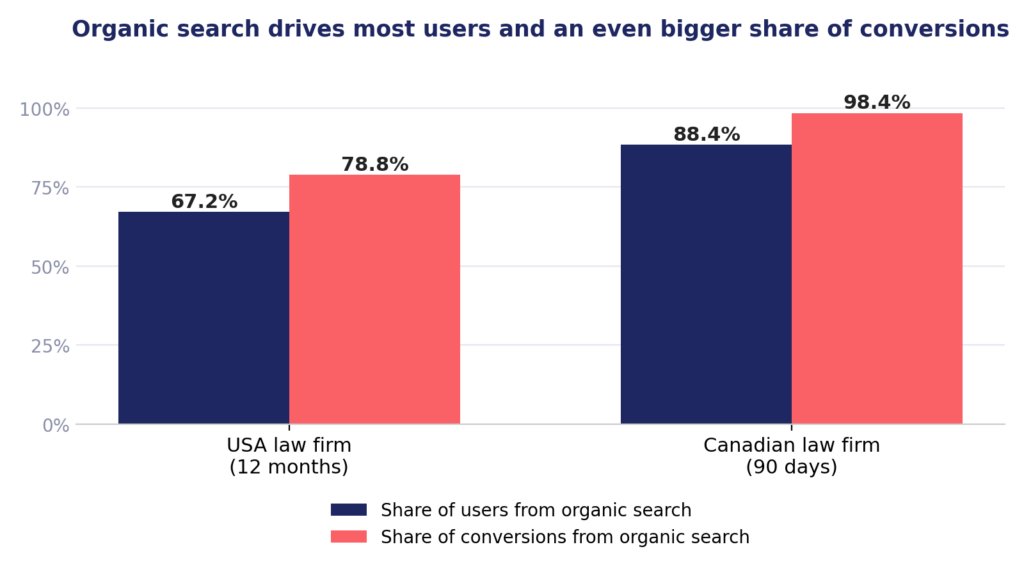
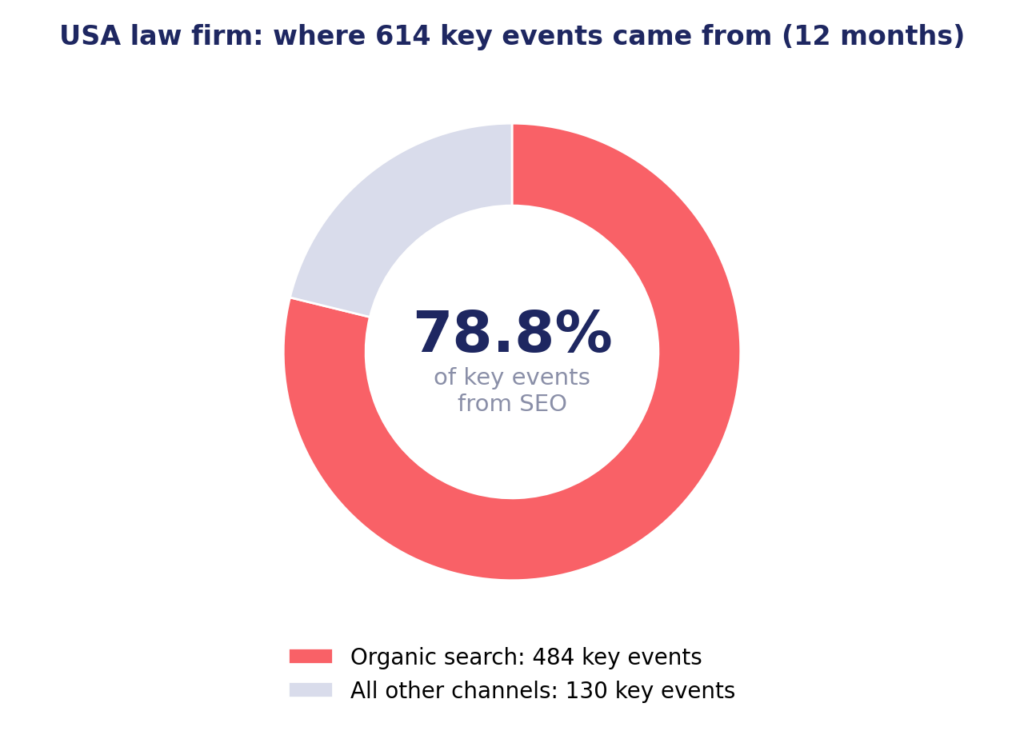
Over 12 months, the USA firm received 5,720 of its 8,517 users from organic search, which is 67.16% of all traffic. More striking, organic search produced 484 of the firm's 614 key events (such as enquiry forms and calls), or 78.83% of all conversions. In the Canadian firm's first 90 days, organic search brought 88.38% of users and 98.41% of key conversions.
Notice the pattern: in both cases organic search contributed a bigger share of conversions than of traffic. Visitors who arrive through search tend to be the ones actively looking for a lawyer, which is why they convert at a higher rate than visitors from more passive channels.
These are results from specific campaigns, not guarantees. Outcomes depend on the practice area, competition, location, and how much work goes into the website and content. But they illustrate a consistent theme: for legal services, SEO often becomes the primary and most cost-effective source of qualified enquiries over time.
Step 1: Build a Page for Every Practice Area
The most common structural mistake on law-firm websites is a single "Services" page that lists every practice area in a paragraph. A search engine cannot rank one page for ten different legal topics, and a visitor with an immigration problem does not want to read about conveyancing to find what they need.
Give each major practice area its own dedicated page, and where it makes sense, separate pages for specific case types underneath it (for example, a family law page with sub-pages for divorce, child custody, and separation agreements). Each page should explain who the service is for, how the process works, typical timelines, what clients should prepare, and what to do next. Specific, genuinely helpful pages beat generic ones every time.
Step 2: Treat Local SEO as a Core Priority
Most legal searches have a geographic element: people want a lawyer who practises in their city, province, or state. A fully completed Google Business Profile, accurate and consistent firm details across the web, location-specific pages, and a steady flow of genuine reviews are the foundations of local visibility. Our detailed walkthrough in Local SEO for Small Businesses: How to Rank in "Near Me" Searches covers each of these elements step by step, and every one of them applies directly to a law firm.
Step 3: Demonstrate Expertise and Trustworthiness
Legal content falls into a category search engines treat with extra care, because inaccurate advice can seriously harm someone. This makes credibility signals especially important. Strong law-firm pages typically include:
- Named lawyer profiles with qualifications, bar or law society admissions, and areas of focus
- Content written or reviewed by a practising lawyer, with the author and review date shown
- Clear information about jurisdiction, so visitors know the content applies to them
- Real client testimonials and case outcomes, presented within the advertising rules that apply to the firm
- Transparent contact details, office address, and a plain-language privacy policy
Step 4: Create Content That Answers Real Client Questions
The best legal content starts with the questions clients actually ask during a first consultation. How long does the process take? What documents are needed? What happens if the application is refused? What will it cost? Answer these honestly and in plain English, and the content serves two audiences at once: prospective clients looking for reassurance, and search engines looking for pages that genuinely resolve a query.
Aim for depth over volume. A handful of thorough, accurate guides on the topics that matter most to your practice will usually outperform dozens of thin posts. Explain things step by step, add a short summary near the top, and finish each page with a clear next step, such as a consultation request or a click-to-call button.
Step 5: Make the Website Fast, Clear, and Easy to Contact
Rankings only matter if visitors act. A person in a stressful situation will not wrestle with a slow page, a hidden phone number, or a long intake form. Mobile speed, a visible click-to-call button, a short enquiry form, and a calm, uncluttered layout all directly affect how many visitors become enquiries. If this is an area for improvement, our guide to UI/UX design mistakes that kill website conversions shows what to look for, and a well-planned website development project can fix the technical foundations behind it.
Step 6: Earn Quality Links and Legal Directory Listings
Backlinks from reputable sources remain a strong trust signal. For law firms, the most valuable ones tend to come from legal directories, bar and law society profiles, local business associations, community sponsorships, and genuine media mentions. A small number of relevant, credible links is worth far more than a large number of low-quality ones, and shortcuts such as bought links carry real penalty risk.
Step 7: Build and Respond to Reviews, Carefully
Reviews influence both local rankings and a prospective client's willingness to make contact. Ask satisfied clients for feedback at the end of a matter, make the process simple, and reply professionally to every review. One important caution: lawyers have confidentiality duties, so replies should never confirm that someone was a client or reveal any detail of a matter, even when answering a critical review.
SEO and Paid Search: Better Together
SEO builds durable visibility, but it takes time. Paid search can generate enquiries immediately while organic rankings develop, and the two feed each other: search-term data from ads shows which phrases actually produce enquiries, which then informs the content plan. In our own work, a Canadian immigration firm generated over 570 qualified leads in six months through Google Ads, while another Canadian legal practice generated 540+ leads at an 8.62% click-through rate and an average cost per lead of CA$25. For firms that want both channels working together, our PPC and SEO services are designed to be planned side by side.
Know Your Advertising Rules
Legal marketing is regulated, and the rules differ between countries, states, and provinces. In some jurisdictions there are strict limits on how lawyers may advertise, what claims they may make about results, and how testimonials may be used. Before publishing marketing content, check the rules set by your local bar association or law society, and have a lawyer within the firm review the wording. Good SEO should never come at the cost of professional compliance.
What to Measure
Metric | What It Tells You |
Organic enquiries (calls + forms) | The metric that matters most: actual leads from search |
Organic conversion rate | How well the site turns search visitors into enquiries |
Rankings for practice-area + location terms | Visibility for the searches that bring in clients |
Google Business Profile calls and direction requests | Local visibility and intent |
Review count and average rating | Trust and local ranking strength |
Returning users from organic search | Whether content keeps people coming back to compare and decide |
A Realistic 90-Day Starting Plan
Period | Focus |
Days 1-30 | Audit the site and Google Business Profile, fix technical issues, set up call and form tracking, research practice-area keywords |
Days 31-60 | Build or rewrite core practice-area pages, add lawyer profiles, improve page speed and the enquiry process |
Days 61-90 | Publish client-question guides, start review collection, build directory listings, review early ranking and enquiry data |
Common Mistakes Law Firms Make With SEO
- One generic services page instead of dedicated practice-area pages
- Copying legal content from other sites or using thin, templated text across locations
- Hiding the phone number or burying the enquiry form
- Ignoring mobile experience, even though many legal searches happen on phones
- Never updating pages after laws, fees, or procedures change
- Chasing rankings without tracking whether they produce real enquiries
Frequently Asked Questions
How long does SEO take to work for a law firm?
Early improvements, such as a better Google Business Profile or fixed technical issues, can show within weeks. Competitive practice areas in large cities generally need several months of consistent work before rankings and enquiries grow meaningfully.
Is SEO better than paid ads for lawyers?
They do different jobs. Paid search is faster; SEO is usually more cost-effective over the long term. Many firms use both, with ads covering the gap while organic rankings build.
Do small and solo practices have a chance against large firms?
Yes, especially in local search. A focused practice with clear practice-area pages, strong reviews, and genuinely helpful content can outrank a larger firm that treats its website as an afterthought.
How often should legal content be updated?
Review key pages at least once or twice a year, and immediately when relevant laws, forms, or fees change. Outdated legal information damages both rankings and trust.
Getting Started
A solid legal SEO plan starts with understanding where a firm currently stands. ARP SoftTech works with law firms on search visibility, lead generation, and website performance, and you can compare available SEO packages, read more guides on our blog, learn about the team on the About Us page, or get in touch to request a free audit of your current website and search presence.
.
Conclusion
Law firms win online by being easy to find, easy to trust, and easy to contact. That means dedicated pages for each practice area, strong local signals, credible and accurate content, a fast and clear website, and a steady stream of genuine reviews, all measured against real enquiries rather than rankings alone. The campaign data above shows what is possible when these pieces work together: organic search becoming the main source of qualified clients. Start with the fundamentals, measure what matters, and build from there.