
Home >> Our Blogs >>Local SEO for Small Businesses: How to Rank in “Near Me” Searches
Introduction
Picture someone standing outside a shopping complex, phone in hand, typing "dentist near me" or "best chai stall near me." That single search, repeated millions of times a day across every city and town, has quietly become one of the most valuable moments in all of marketing — because the person searching isn't browsing, they're ready to walk through a door. For a small business, showing up in that moment, or not, can be the difference between a full appointment book and an empty one.
Local SEO is the discipline of making sure a business shows up for exactly these searches — the ones tied to a specific place, whether that's a neighbourhood, a city, or "nearby." Unlike broader SEO, which competes for attention nationally or even globally, local SEO plays a fairer game: a well-optimized shop in Kankarbagh doesn't need to outrank a national chain's homepage, it just needs to outrank the three or four other local shops competing for that same nearby customer. This guide walks through exactly how that ranking works and what a small business can realistically do about it.
What Makes Local SEO Different From Regular SEO
Traditional SEO chases visibility for a topic or keyword regardless of where the searcher is standing. Local SEO adds a second, often more important, dimension: proximity and place. A search for "how does SEO work" pulls up educational content from anywhere in the world. A search for "SEO agency near me" pulls up a completely different set of results — a map, a handful of local business listings, and only then the usual list of websites.
This is why a business can rank on page one nationally for a broad industry term and still be invisible to the customer standing three streets away, simply because local ranking factors were never addressed. The two skill sets overlap, but they aren't the same job, and treating them as identical is one of the most common reasons small business websites underperform locally despite having decent content.
How Google Actually Decides Local Rankings
Google has been fairly open about the three factors that decide who appears in local results: relevance, distance, and prominence.
Relevance — how well a business profile and website match what the person is searching for. A generic "General Store" category will lose to a specific, accurately chosen one every time.
Distance — how close the business is to the location implied in the search, whether that's a typed city name or the searcher's actual GPS position.
Prominence — how well-known and well-regarded the business is, based on signals like review volume, review quality, backlinks, and general online presence.
A business can't do much about distance for any individual search — it either happens to be close or it doesn't. But relevance and prominence are almost entirely within a business's control, and that's where the real work of local SEO lives.
Claiming and Optimizing Your Google Business Profile
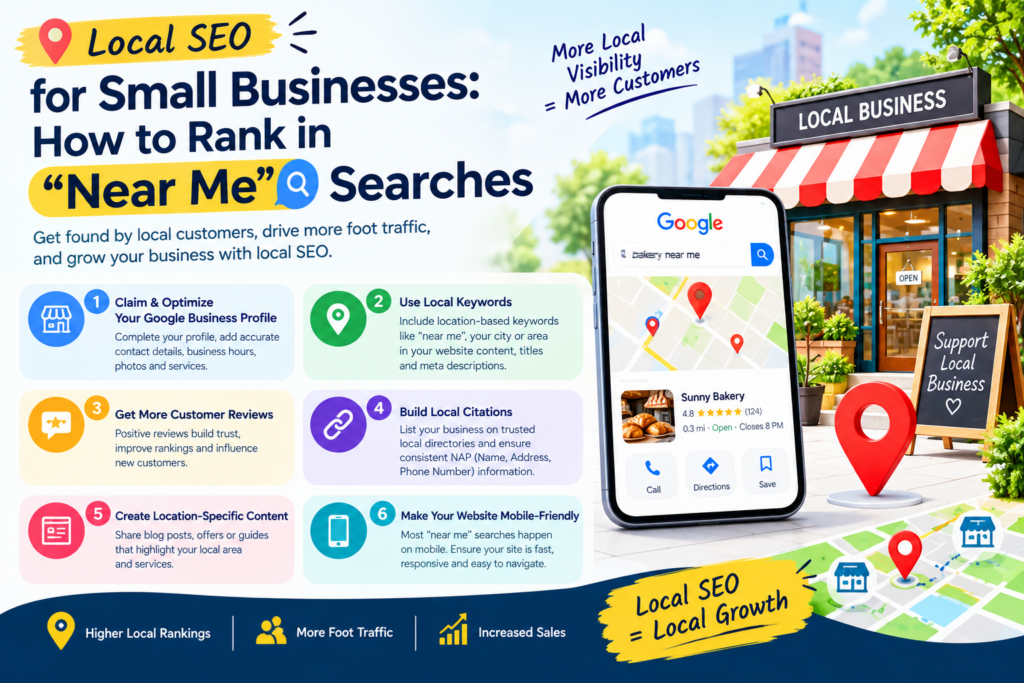
If a small business does only one thing from this entire guide, it should be this: claim, verify, and thoroughly fill out a Google Business Profile. It's free, it's the single biggest lever in local search, and an alarming number of local businesses either never claim it or leave it half-finished.
Get the basics exactly right
Business name, address, and phone number need to match exactly what's printed on a signboard or invoice — no keyword-stuffing the business name ("Sharma Electronics – Best AC Repair Patna" instead of just "Sharma Electronics"), which violates Google's guidelines and can get a listing suspended.
Choose categories carefully
The primary category should be the single most accurate description of the core business, with secondary categories added only where genuinely relevant. A restaurant that also does catering should list catering as a secondary category, not force it into the primary spot.
Add real photos regularly
Listings with recent, genuine photos of the storefront, products, team, and interior consistently outperform listings using stock images or no images at all. Aim to add a few new photos every month rather than uploading ten once and forgetting about it.
Use Posts and Q&A actively
Google Business Profile allows short posts (offers, updates, events) and a public Q&A section. Both are underused by most small businesses, which makes them an easy way to stand out — and answering your own frequently asked questions proactively in the Q&A section prevents incorrect answers from other users.
On-Page Local SEO: What the Website Itself Needs
NAP consistency across the entire site
Name, Address, and Phone number (NAP) should appear identically on every page, typically in the footer, and match the Google Business Profile exactly. Inconsistent formatting — "Rd" on one page and "Road" on another — sounds trivial but genuinely confuses the trust signals search engines rely on.
Dedicated location or service-area pages
A business serving multiple areas benefits from a dedicated page per major location or service area, each with unique content describing that specific area rather than a single generic page repeated with the city name swapped out. Thin, duplicate-feeling location pages tend to hurt more than they help.
Local schema markup
Adding LocalBusiness structured data to a website's code helps search engines understand address, hours, and service area with certainty, rather than inferring it from plain text. This is a technical step best handled as part of a proper website development or SEO engagement, since incorrect schema can do more harm than none at all.
Genuine local content
Blog posts or guides that reference real local context — neighbourhood names, local events, region-specific questions — signal relevance in a way generic content never can, and often become the exact page that ranks for a long-tail "near me" variation.
Building Local Citations and Directory Listings
A citation is any online mention of a business's name, address, and phone number, whether or not it links back to the website — think Justdial, IndiaMART, Sulekha, industry-specific directories, and local chamber-of-commerce listings. Search engines treat a consistent pattern of citations across the web as a trust signal, similar to how multiple people independently confirming an address makes it more believable.
The priority isn't quantity; it's consistency. A handful of accurate, well-chosen citations on relevant, reputable directories outperforms dozens of citations on low-quality sites with slightly different address formatting on each one.
Reviews: The Local Trust Currency
Review count and review quality feed directly into the "prominence" factor Google uses to rank local results, and they influence human decision-making even more directly — most people simply won't choose a business with no reviews over a similar one with fifty genuine, positive ones.
- Ask happy customers directly and immediately, right after a positive interaction, rather than hoping they'll remember to do it later
- Make it easy: a direct link or QR code to the review page removes friction that kills good intentions
- Respond to every review, good or bad — a thoughtful reply to a negative review often reassures future customers more than the review itself worried them
Never buy fake reviews; platforms are increasingly effective at detecting and penalizing this, and the damage to trust when discovered is severe
Mobile and Voice Search Matter More Locally Than Anywhere Else
"Near me" searches are overwhelmingly performed on phones, often while someone is already out and moving, and a meaningful share now happen by voice rather than typing. This raises the bar on website speed and mobile usability specifically for local searchers, who are the least patient audience on the internet — someone standing outside in the heat is not going to wait for a slow-loading menu page. Investing in UI/UX design that loads fast and works cleanly on a small screen is, in a very real sense, a local SEO tactic, even though it doesn't look like one at first glance.
Common Local SEO Mistakes Small Businesses Make
- Leaving the Google Business Profile unclaimed, or claimed but abandoned with outdated hours and no photos
- Using a call-tracking number that doesn't match the number listed everywhere else online
- Writing one generic "About Us" page instead of location-specific content for each area served
- Ignoring negative reviews instead of responding professionally and promptly
- Treating local SEO as a one-time setup task instead of an ongoing effort that needs fresh photos, posts, and reviews
Measuring Whether It's Working
Vanity metrics like overall website traffic don't tell the full local story. More useful indicators include Google Business Profile insights (views, direction requests, and calls generated directly from the listing), ranking position for a handful of core "[service] near me" and "[service] in [city]" phrases tracked monthly, and — most importantly — how many actual calls, form fills, or walk-ins can be traced back to a Google search. Reviewing these numbers monthly makes it easy to spot whether a listing is quietly slipping or genuinely improving.
Frequently Asked Questions
How long does local SEO take to show results?
Some improvements, like a fully completed Google Business Profile, can show a visible bump within a few weeks, while competitive categories in dense cities may take a few months of consistent citations, reviews, and content before meaningful movement appears.
Does a business need a website to rank locally?
A Google Business Profile alone can generate some visibility, but a proper website significantly strengthens rankings and gives the business a place to convert that visibility into an actual booking or sale, rather than just an entry in a list.
Is local SEO only relevant for businesses with a physical storefront?
No. Service-area businesses — plumbers, consultants, home tutors, event planners — benefit just as much, since customers searching for these services almost always add a location qualifier even without a shop to visit.
How many reviews does a business actually need?
There's no fixed number, but consistency matters more than volume — a business steadily gaining a few genuine reviews every month tends to perform better over time than one that gathered fifty reviews once and then stopped.
Where to Go From Here
Getting local search right usually means combining a properly optimized Google Business Profile with a website built to support it. Businesses looking for a structured approach can explore SEO packages, pair local visibility with consistent social media marketing to build the reviews and reputation that support it, or get in touch for a specific audit of how a business currently appears in local search results.
Conclusion
Local SEO rewards businesses that treat their online presence the way they'd treat their physical shopfront — accurate, current, well-presented, and cared for regularly rather than set up once and ignored. A small business that gets its Google Business Profile right, keeps its details consistent everywhere online, and earns genuine reviews over time will often out-rank far bigger competitors for the searches that matter most: the ones from someone nearby, ready to buy, right now.