
Home >> Our Blogs >>Off-Page SEO: How to Build Authority and Earn Backlinks That Actually Count
Introduction
Two websites can publish equally good pages, load equally fast and target the same keywords, and still rank very differently. The usual reason is not on the page at all. It is what the rest of the internet says about each site: who links to it, who mentions it, who recommends it and whether real people seem to trust it.
That is the core idea behind off-page SEO. Search engines cannot judge a business only by what it says about itself, so they look for outside evidence. This guide explains what that evidence is, which tactics build it honestly, which ones put your site at risk, and how to put together a realistic plan, whether you are a small business owner or the person responsible for a company's growth.
What Off-Page SEO Really Means
Off-page SEO covers everything that influences your visibility and reputation away from your own website. It is often reduced to "getting backlinks," but links are only one part. The wider picture includes brand mentions (with or without a link), digital PR and media coverage, reviews and local listings, expert contributions on other sites, partnerships, and the way people talk about you in communities and on social platforms.
It helps to keep three layers separate:
- On-page SEO: the content, structure and tags on your own pages
- Technical SEO: how well search engines can crawl, render and index your site
- Off-page SEO: the authority and trust your brand earns elsewhere
The three work together. Strong off-page signals cannot rescue a slow, confusing site, and a flawless site with no outside recognition often struggles to compete for valuable terms.
Why It Matters More Than Ever
Links remain one of the signals search engines use to judge which pages deserve to rank, and in competitive markets they are often what separates the top results from the rest. But the picture has widened. AI-generated answers and conversational search tools draw on what the web collectively says about a brand, so being mentioned consistently by credible sources can support visibility even when nobody clicks through.
This changes the goal. The aim is no longer to collect as many links as possible. It is to become a business that other credible sites and real people have good reasons to mention.
What Makes a Backlink Worth Having
Not all links are equal. One link from a respected, relevant site can outweigh dozens from irrelevant or low-quality sources. When evaluating a link opportunity, think about these qualities:
Quality | A Strong Link | A Weak or Risky Link |
Relevance | From a site in your industry or a closely related topic | From a site with no connection to your field |
Editorial value | Given because your content is genuinely useful | Placed in exchange for payment or a swap scheme |
Site quality | Real audience, real content, active publication | Thin pages, scraped content, link-farm feel |
Context | Naturally placed inside helpful content | Hidden in footers, sidebars or spammy comments |
Anchor text | Natural wording, brand name or page topic | Repeated exact-match keyword phrases |
Traffic potential | Page that actually receives visitors | Page nobody visits or reads |
One more point: links marked "nofollow" are not worthless. Search engines treat that attribute as a hint rather than a command, and such links still bring visitors, brand exposure and a natural-looking link profile.
Six Off-Page Strategies That Build Lasting Authority
1. Create assets worth linking to
People link to things that help them. Original research, practical calculators, templates, thorough how-to guides, industry benchmarks and clear visual explainers all give other writers something to cite. The key is genuine usefulness: ask what you can publish that is more helpful, more current or more specific than what already exists. Even a small business can do this by sharing real, anonymised insights from its own work, such as what it has learned from client projects.
2. Practise digital PR
Digital PR means earning coverage by being newsworthy or helpful to journalists, bloggers and industry publications. That can mean responding to reporters' requests for expert comment, offering data or a fresh angle on a trending topic, or sharing a milestone that is of real interest to your sector. It is slower than buying links, but a single mention on a respected publication carries credibility that is hard to manufacture.
3. Contribute guest content with integrity
Writing for other websites remains effective when it is done for the right reason: sharing real expertise with an audience that will value it. Choose publications your customers actually read, pitch specific ideas rather than generic topics, and write articles you would be proud to publish on your own site. Avoid mass guest-post networks and sites that accept anything for a fee, since they tend to be exactly what search engines discount.
4. Reclaim mentions and fix lost links
This is one of the most efficient tactics available. Someone may already be mentioning your brand without linking to you, and a polite note thanking them and suggesting a link to the relevant page often works. Likewise, check for links that have been lost to deleted pages, changed URLs or broken redirects, and restore them. Set up alerts for your brand name so you can find mentions as they appear.
5. Build reputation through reviews and listings
Reviews, accurate business listings and consistent contact details strengthen trust, especially for businesses serving a local area. A steady flow of genuine reviews and complete profiles supports both rankings and conversion. Our guide to local SEO for small businesses covers listings and reviews in practical detail, and for professional practices, our article on SEO for law firms shows how credibility signals work in a high-trust industry.
6. Show up where your audience already gathers
Forums, professional communities, Q&A sites, podcasts, webinars and industry events are places where useful contributions earn recognition and sometimes links. Social platforms rarely pass direct ranking value, but they widen reach, help content get discovered by writers who might link to it, and build the familiarity that leads to branded searches. Consistent social media marketing supports this, as long as the goal is to be helpful rather than to push links.
Choosing Where to Start
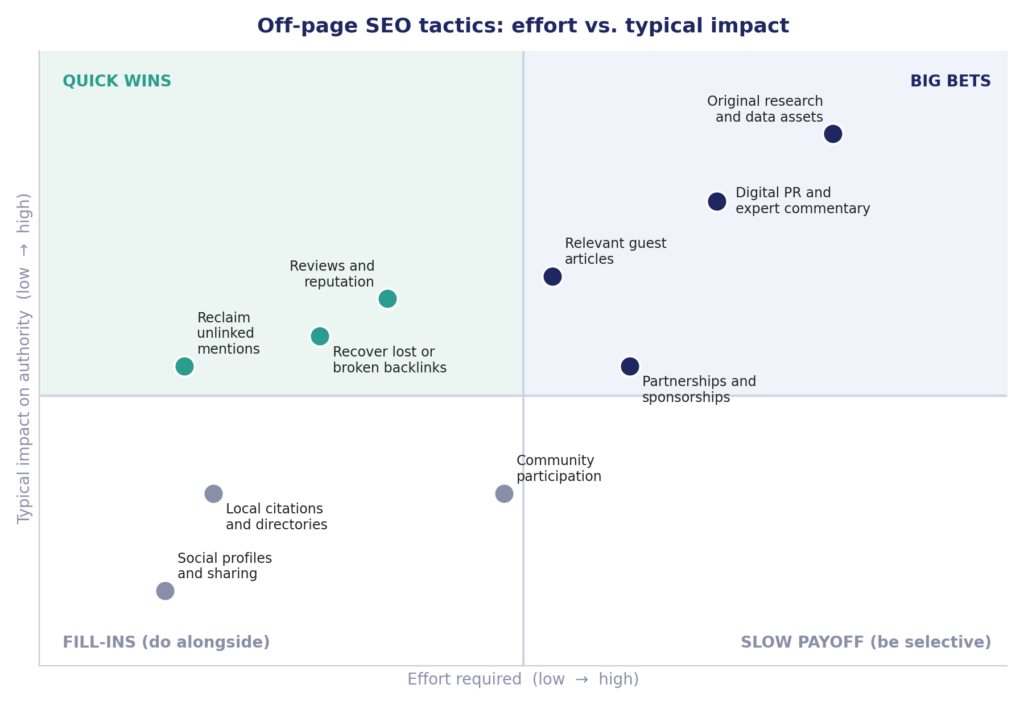
With limited time, it helps to know which tactics repay the effort. The chart below places common off-page activities by how much effort they typically need and how much authority they tend to build.
A sensible order for most businesses is to start with the quick wins, such as reclaiming mentions, fixing lost links and strengthening reviews and listings, while working toward one or two big bets like a genuinely useful research piece or a steady digital PR habit.
Tactics to Avoid
Search engines publish clear policies against link schemes, and they have become better at ignoring or penalising manipulative patterns. These are the common traps:
- Buying links or paying for "guest posts" whose only purpose is a link
- Private blog networks and sites created purely to link to other sites
- Large-scale link exchanges ("link to me and I will link to you")
- Mass directory submissions and blog comment spam
- Stuffing links with identical exact-match keyword anchors
- Automated outreach or AI-generated articles published at scale on weak sites
Such tactics may produce a short-term bump, but the downside is a ranking drop that can take months to repair. If your site already has a history of questionable links, an audit can show whether anything needs cleaning up. Remember too that scores such as "domain authority" or "spam score" are third-party estimates from tools, not Google ranking factors, so use them as rough guides rather than targets.
A Practical Way to Plan Your Effort
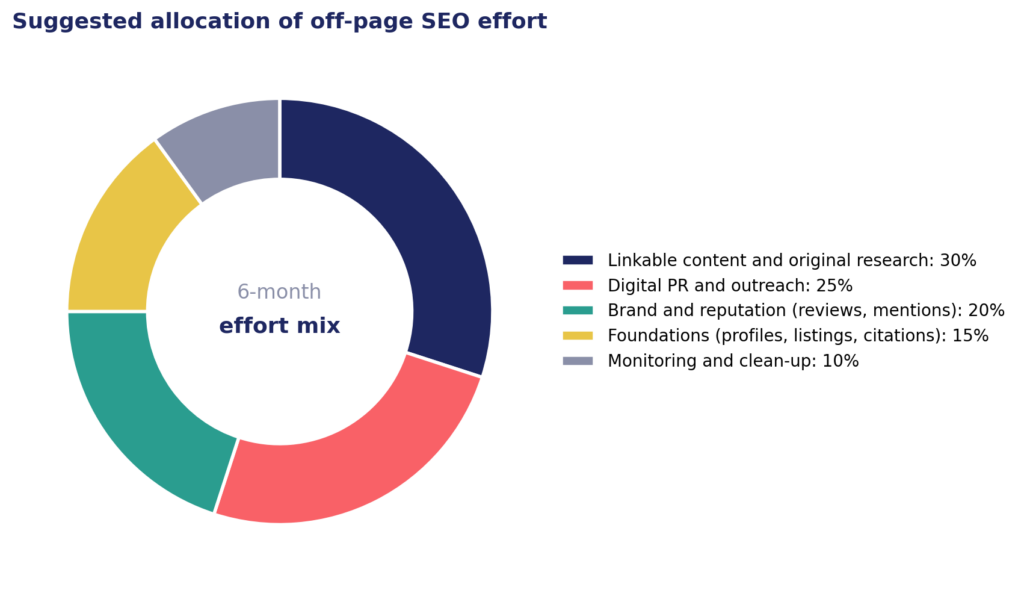
Off-page SEO is easy to approach in a scattered way. A simple allocation keeps it balanced. For the first six months, many small and mid-sized businesses do well by putting the biggest share into content people will want to cite, followed by outreach, then reputation work, with smaller slices for foundations and monitoring.
Strong Foundations Come First
Outside recognition only pays off when visitors arrive at a site that deserves it. Before investing heavily in links, make sure your pages are fast, clear and trustworthy. Sound website development and thoughtful UI/UX design turn the attention you earn into enquiries, and a well-organised SEO foundation ensures the authority you build flows to the right pages. Paid campaigns can also complement earned visibility, as explained in our comparison of Google Ads vs Meta Ads.
How to Run Outreach Without Being Annoying
Most outreach fails because it is generic. A few principles make a real difference:
- Research the person first and mention something specific about their work
- Lead with value: explain what is useful about your resource for their audience
- Keep emails short, clear and easy to answer
- Never demand a link; offer something worth linking to
- Follow up once or twice politely, then move on
- Thank people who respond, whether or not they link
How to Measure Progress
Rankings move slowly, so track a mix of leading and lagging indicators:
What to Track | Why It Matters |
New referring domains (quality over count) | Shows whether credible, relevant sites are starting to reference you |
Branded search growth | A sign that more people know and look for your brand by name |
Rankings for the pages you promoted | Connects off-page effort to actual search visibility |
Referral traffic and engagement | Confirms links bring real, interested visitors |
Brand mentions found and converted | Measures how well you reclaim unlinked mentions |
Review volume and rating | Reflects trust and supports local visibility |
Google Search Console shows which sites link to you, free alerts can notify you of brand mentions, and third-party backlink tools provide competitor comparisons. Review the numbers monthly and look for trends rather than daily changes.
A 90-Day Starting Plan
Period | Focus |
Days 1-30 | Audit your current links and mentions, review competitors' link sources, fix lost links, complete business profiles, set up brand alerts |
Days 31-60 | Create one genuinely useful, link-worthy resource, start outreach to relevant publications, begin a steady review process |
Days 61-90 | Publish expert contributions, pursue digital PR opportunities, reclaim mentions, review progress and refine the plan |
Common Mistakes
- Chasing link volume instead of relevance and quality
- Using the same anchor text again and again
- Treating off-page SEO as a one-time project instead of an ongoing habit
- Ignoring on-page and technical problems that waste the authority you earn
- Hiring a provider that promises a fixed number of links or guaranteed rankings
- Never checking what the existing link profile looks like
Frequently Asked Questions
How long does off-page SEO take to work?
Early signals such as new mentions and referral visits can appear within weeks, but ranking improvements from authority building usually take several months, and competitive topics take longer.
Are backlinks still important?
Yes. Links remain one of the signals search engines use, though relevance, quality and the wider reputation of your brand matter far more than raw numbers.
Do unlinked brand mentions help?
They can support recognition and trust, and they are often easy to convert into links by contacting the writer. Either way, being talked about by credible sources is a healthy sign.
Is it safe to buy backlinks?
Paying for links to influence rankings goes against search engine guidelines and carries a real risk of ranking loss. It is safer to invest the same budget in useful content, outreach and genuine partnerships.
Does a small business need off-page SEO?
Yes, in proportion. For a local business that mostly means strong reviews, consistent listings and a few relevant local mentions rather than a large link-building campaign.
Where to Go From Here
If you would like help building authority the right way, you can explore our SEO packages, read more guides on the blog, learn about the team on the About Us page, or get in touch for a review of your current backlink profile and brand presence.
Conclusion
Off-page SEO is, at heart, reputation building. The businesses that do it well are not the ones that collect the most links; they are the ones that give people good reasons to talk about them. Create something worth citing, show up where your audience pays attention, treat reviewers and writers with respect, avoid shortcuts that put your site at risk, and keep measuring what changes. Authority built this way takes time, but it lasts and it is much harder for competitors to copy.