
Home >> Our Blogs >>How Much Does SEO Cost in India? Pricing Models and What Affects the Price
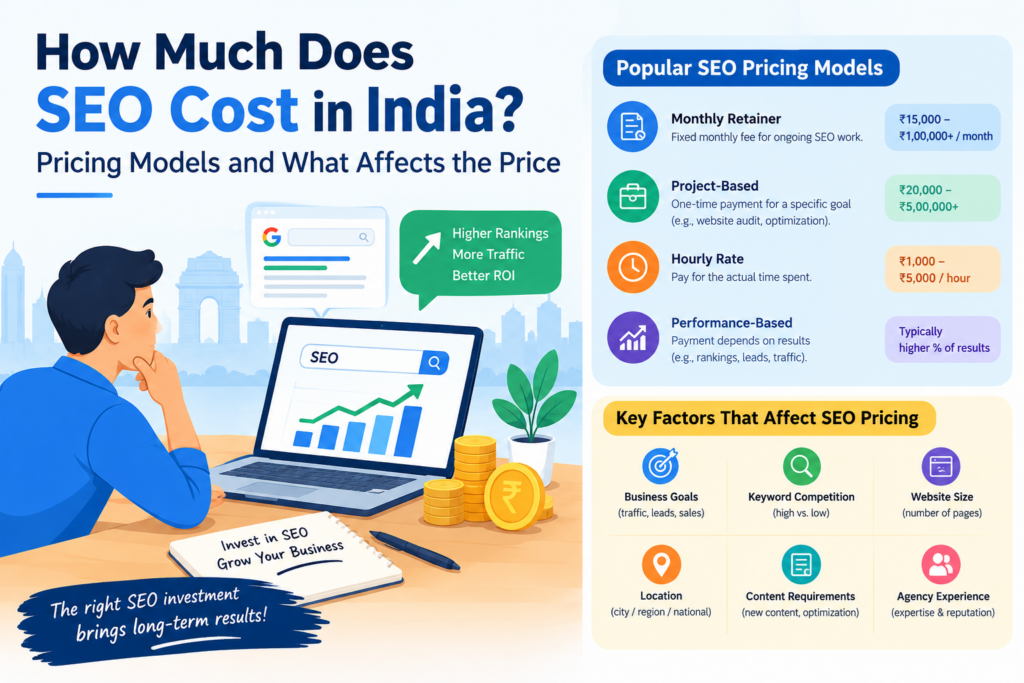
Introduction
Ask three agencies what SEO will cost and you may get three answers that are lakhs of rupees apart. One quotes a few thousand rupees a month. Another quotes ten times that. A third wants a six-figure retainer. All of them promise to "improve your rankings," which makes the decision feel impossible.
The confusing part is that all three quotes can be honest. SEO is not a fixed product like a domain name or a hosting plan. It is a mix of technical work, content, outreach and analysis, and the amount of each depends on your website, your competitors and your goals. This guide explains the pricing models you will meet in India, the typical ranges businesses see, what actually pushes the price up or down, and how to judge whether a quote is good value.
The Short Answer
Across the 2026 pricing guides we reviewed from Indian agencies, monthly SEO retainers commonly fall between about ₹10,000 for a basic freelancer-level engagement and ₹1.5 lakh or more for a serious programme, with enterprise work going well beyond that. Most small and growing businesses land somewhere in the ₹25,000 to ₹75,000 range, depending on scope and competition.
Please treat every figure in this article as indicative. These ranges come from published agency guides, which are written by businesses that sell SEO, and individual quotes vary widely. They are a way to understand the market, not a price list. The most reliable number is always a proposal scoped to your own website
The Main SEO Pricing Models
Model | How It Works | Best For | Watch Out For |
Monthly retainer | Fixed monthly fee for an agreed scope of ongoing work | Most businesses; SEO needs sustained effort | Vague scope; reports that show activity but not results |
Project-based | One-off fee for a defined piece of work such as an audit, migration or site clean-up | Fixing a specific problem or starting with a diagnosis | Nothing continues after the project ends |
Hourly or day rate | You pay for time spent, usually for consultants | Advice, training or small tasks | Costs can grow quickly without a cap |
Performance-based | Fee tied to rankings, leads or revenue | Businesses wanting shared risk | Rankings alone can be gamed; agree on the exact metric and time frame |
Hybrid | Smaller retainer plus a bonus linked to results | Growing brands with clear targets | Needs clear tracking so both sides trust the numbers
|
Monthly retainers are the most common arrangement in India, because search rankings build over months rather than days. A one-time "SEO package" with no continuing work rarely delivers lasting results on its own, unless it is a specific project such as an audit.
What Different Providers Typically Charge
Price also depends on who does the work. Freelancers usually cost less but have limited capacity. Small and mid-size agencies offer a team across technical, content and outreach. Large agencies and enterprise programmes bring more resources and process, along with much higher fees.
Real quotes overlap these bands. A skilled freelancer can outperform a weak agency, and a large name does not guarantee better results for a small local business. What matters is who will actually do the work, how experienced they are and how clearly the scope is defined.
What Different Types of Business Typically Pay
Scope matters as much as the provider. A single-location shop and a national online store need very different amounts of work.
- Local single-location businesses: focus on Google Business Profile, local pages, citations and reviews, so the workload is smaller
- Startups and growing SMBs: need a mix of technical fixes, on-page work and regular content to compete
- Ecommerce stores: carry extra work for category and product pages, structured data and content at scale
- B2B and enterprise: face high competition, long sales cycles and heavier content and outreach needs
The Factors That Move the Price
1. Competition and keyword difficulty
Ranking for a phrase few businesses target is far cheaper than competing with established brands for a valuable term. The tougher the competition, the more content, authority building and time it takes.
2. The condition of your website
A site with slow pages, crawl errors or messy structure needs repair work before growth work can pay off. This "technical debt" often adds cost in the first few months, then settles into a lower ongoing fee.
3. Content volume and quality
Pages, guides and product descriptions written by genuine experts cost more than thin, templated text, and they perform better. Retainers that include several well-researched pieces each month naturally cost more than ones with no content.
4. Link building and digital PR
Earning credible mentions and links takes outreach, relationships and good material to share. Beware of anything cheap that promises large numbers of links, because quality links are earned rather than mass-produced.
5. Geographic scope
Ranking in one city is a smaller job than ranking across several cities or nationally. Each extra location or country adds pages, listings and competition to manage.
6. Industry
Fields where accuracy is critical, such as healthcare, law and finance, need more careful content and review. Highly competitive sectors such as SaaS and ecommerce also tend to cost more.
7. Reporting, tools and expertise
Quality tools, deeper analysis and clear reporting take time and subscriptions. More experienced specialists also charge more, but often work faster and avoid costly mistakes.
What Your Budget Should Include
Rather than comparing only the monthly number, compare what is actually included. As a rough guide drawn from published agency guides, higher-priced tiers typically add more of the following:
Budget Level | What It Usually Covers |
Entry level | Keyword research for a small set of terms, on-page fixes on a handful of pages each month, Google Business Profile support for local businesses, basic reporting |
Mid level | Wider keyword targeting, regular new content, a technical review, light link building and more frequent reporting |
Advanced | Competitor gap analysis, steady content production, structured outreach, ongoing technical audits and detailed reporting tied to leads or revenue |
The exact deliverables differ by provider, so ask for them in writing: how many pages will be optimised, how many pieces of content will be produced, what link building involves and what the report will contain.
How Long Before SEO Pays Off?
Most businesses need a few months to see steady movement, and competitive topics take longer. The first month or two usually goes on audits, fixes and planning, with visible gains building in the following months. This is another reason cheap one-month packages disappoint: the work simply has not had time to compound.
Red Flags in SEO Quotes
- Guaranteed number-one rankings or guaranteed results within a fixed period
- Very low fixed prices that promise hundreds of backlinks or directory submissions
- No written scope, or deliverables described only as "SEO optimisation"
- Reports that show rankings and traffic but never mention enquiries or sales
- Refusal to explain the methods used or who will do the work
- Pressure to sign a long lock-in with heavy exit penalties
- The agency keeping ownership of your website, analytics or accounts
Is It Worth It? Thinking in Terms of Return
A monthly fee only makes sense when compared with what SEO can bring in. A simple way to check is a break-even calculation. Here is an illustrative example, not a forecast.
- Assume a business pays ₹40,000 per month for SEO
- Its average sale is ₹15,000 with a 40% profit margin, so each sale earns ₹6,000 in profit
- Break-even is about 7 extra sales per month (₹40,000 divided by ₹6,000)
If SEO is realistically likely to bring that many extra customers once it has built momentum, the investment makes sense. If not, a smaller scope or a different channel may be wiser. For high-value services such as legal, healthcare or B2B, a handful of extra clients can cover the cost easily; for low-margin products the arithmetic is tighter.
It is also worth comparing SEO with paid advertising. Ads can bring faster enquiries while you pay for each click, whereas SEO usually takes longer but can keep delivering without a cost per click. Our comparison of Google Ads vs Meta Ads explains how to weigh paid channels, and our overview of PPC covers how campaigns are structured.
Questions to Ask Before You Hire
- What exactly is included each month, and what counts as extra?
- Who will work on my account, and how experienced are they?
- How will you report, and will results be linked to enquiries or revenue?
- Is GST included in the quote? (Many agency quotes are shown before GST, which is currently charged at 18% on most such services, so please confirm the current rate.)
- What is the contract length, and how can I exit if it is not working?
- Will I own my website, analytics and search accounts throughout?
The same questions apply whether you are comparing agencies, freelancers or an in-house hire.
Fixing the Foundations Can Lower Long-Term Costs
Some of the most effective ways to make an SEO budget go further are not SEO tasks at all. A fast, well-built site reduces the amount of technical repair work needed, and good website development and clear UI/UX design help turn the traffic you earn into enquiries. If you serve local customers, strengthening your profile and reviews first, as explained in our local SEO guide, often delivers the best early return per rupee.
Frequently Asked Questions
Is cheap SEO worth it?
Very low prices usually mean very little attention or work that cuts corners. A small budget can work if the scope is also small and clearly defined, for example a local business focusing on its Google profile and a few key pages, but it is unrealistic to expect national-level results from it.
Should I pay per keyword?
Some providers price by the number of keywords. It looks simple but can be misleading, because keywords differ enormously in difficulty and value. A better approach is to price by the work involved and tie it to business results.
Can I do SEO myself to save money?
Yes, especially at the start. Owners can handle basics such as their Google Business Profile, simple on-page fixes and helpful content. Many then bring in a professional for technical audits and link building, where experience saves time and prevents mistakes.
Is a freelancer cheaper than an agency?
Usually, but capacity and breadth differ. A freelancer may be ideal for a focused project, while an agency suits businesses that need content, technical work and outreach together.
Are one-time SEO packages effective?
They can work for specific projects such as an audit or a site migration. For ongoing growth, SEO generally needs continuing effort, since competitors and search results keep changing.
Where to Go From Here
The best way to find out what SEO would cost for your own website is to start with an audit and a clear scope. You can compare ARP SoftTech's SEO packages, read more about our SEO approach, browse more guides on the blog, or get in touch for a proposal based on your goals and competition.
Conclusion
There is no single price for SEO in India, but there is a sensible way to approach it. Understand the pricing models, expect ranges that depend on your provider type, business and competition, compare what each quote actually includes, and measure the cost against what a new customer is worth to you. Be cautious of guarantees and very low prices, ask for a clear written scope, and give the work enough time to build. A well-chosen SEO investment is less an expense than a long-term asset that keeps bringing in customers.