
Home >> Our Blogs >>Digital Marketing for Healthcare Providers: Attracting Patients Ethically
Introduction
Choosing a doctor, a clinic or a hospital is not like choosing a restaurant. People search for healthcare when they are worried, in pain, or making a decision that affects their family. They read carefully, compare quietly, and look for signs that a provider is honest and competent before they ever pick up the phone. That makes digital marketing in healthcare both powerful and delicate.
Done well, it helps patients find accurate information and the right care sooner. Done badly, it can mislead, expose private data, or damage the one thing a healthcare provider cannot afford to lose: trust. This guide explains how clinics, hospitals, diagnostic centres and individual practitioners can attract patients online in a way that is effective, honest and compliant.
Why Healthcare Marketing Is Different
Several things set healthcare apart from almost every other industry that markets online:
- High stakes: search engines treat health content as a sensitive category, because inaccurate advice can cause real harm. Content is held to a higher standard of expertise and accuracy.
- Emotional decisions: patients are often anxious. Aggressive sales tactics that work for retail feel wrong, and are wrong, in a medical setting.
- Strict rules: advertising by medical professionals is regulated in most countries, and privacy laws apply to patient information.
- Trust above all: patients choose based on credibility, credentials, reviews and how safe a provider feels.
The good news is that these constraints point toward a strategy that also happens to work: be genuinely helpful, be transparent, and make it easy for the right patients to find you.
The Ethical Foundation: A Simple Do and Avoid List
Do | Avoid |
Share accurate, clearly sourced health information | Promising cures, guaranteed outcomes or "miracle" results |
Show real credentials, qualifications and experience | Exaggerating qualifications or implying approvals you do not hold |
Use patient stories and photos only with explicit written consent | Posting patient images, records or identifiable details without permission |
Ask satisfied patients for honest reviews | Buying, faking or incentivising reviews in ways that break platform rules |
Explain services and costs clearly | Fear-based messaging designed to pressure people into treatment |
Include a plain-language privacy notice and secure forms | Collecting health details through unsecured forms or tracking tools |
Know the Rules That Apply to You
Healthcare advertising is regulated, and the rules differ by country, profession and specialty. In India, for example, doctors are subject to their medical council's professional conduct and advertising rules, advertising of certain remedies and claims is restricted by law, consumer protection rules prohibit misleading advertisements, and the Digital Personal Data Protection Act affects how patient data is handled. Providers in the United States must consider HIPAA, those in Europe and the UK must consider GDPR, and other regions have their own equivalents.
Ad platforms add their own policies too. Google and Meta both apply stricter rules to health-related ads, including limits on targeting based on health conditions and on certain before-and-after imagery, and some categories need prior approval. This article is general information and not legal advice, so confirm the current rules with your medical council, a qualified advisor or your legal counsel before you publish anything.
When Meta Ads Is the Smarter First Move
Meta tends to win when people do not yet know they want what you sell, or when the product sells itself through how it looks.
- Visual or lifestyle products such as fashion, jewellery, home decor, food, beauty and gifting
- New brands or launches that need awareness before anyone will search for them by name
- Offers that suit impulse or emotional decisions, such as events, courses, classes or promotions
- Businesses whose customers prefer to message first, where click-to-WhatsApp or Messenger ads shorten the path to a conversation
Meta also works hand in hand with organic social. Strong posts and Reels give paid campaigns better creative to promote, which is why a consistent social media marketing presence usually improves paid results rather than competing with them.
Step 1: Build a Website Patients Can Trust
Your website is the first impression for almost every new patient, and in healthcare it has to answer three questions quickly: who are you, can I trust you, and how do I get care? That means clear doctor profiles with qualifications and areas of focus, services explained in plain language, visible contact details and a simple way to book. A professional website development process should also deliver fast loading, mobile-friendly pages and accessibility for older patients and people with disabilities.
Design matters as much as technology. Large readable text, calm layouts, uncluttered booking forms and obvious phone buttons reduce friction for stressed visitors. Our guide to UI/UX design mistakes that hurt conversions covers the common problems, and thoughtful UI/UX design is especially valuable on appointment and enquiry pages.
Step 2: Be Findable Locally
Most patients look for care near them, so local visibility is the backbone of healthcare marketing. A fully completed Google Business Profile with correct categories, hours, services, photos of the facility and accurate contact details helps people find and trust you on maps and in local results. Consistent name, address and phone details across directories reinforce it. The principles are the same as for any local business, and our guide to local SEO for small businesses walks through each element in detail.
Create dedicated pages for each department, specialty or treatment, and for each location if you have more than one. A single page listing every service can neither rank well nor help a patient who wants to know about one particular condition or procedure.
Step 3: Publish Helpful, Reviewed Health Content
Patients search for symptoms, procedures, recovery times and costs long before they choose a provider. Clear, accurate articles that answer those questions build trust and bring in the right audience. Strong content is written in plain language, reviewed by a qualified clinician, dated, and updated when guidance changes. A structured SEO strategy helps ensure these pages can be found, but accuracy always comes first.
- Show the author or medical reviewer and their credentials on each article
- Link to reputable sources for medical statements
- Include a note that the content is for information and does not replace a consultation
- Avoid diagnosing, promising results or suggesting that readers skip professional care
- Add an FAQ at the end of each page covering the questions patients genuinely ask
Step 4: Handle Reviews and Reputation Responsibly
Reviews strongly influence both local rankings and patient choice. Invite feedback from patients through a simple link or QR code after an appointment, and respond to every review professionally. There is one rule that deserves extra care: patient confidentiality. Never confirm that a reviewer was your patient, and never discuss any detail of their care in a public reply, even to correct a mistake. A calm, general response such as an invitation to contact the clinic offline protects both the patient and the practice.
Do not offer discounts or gifts in exchange for positive reviews, do not write reviews yourself, and do not pressure staff to post them. Platforms detect these patterns, and the loss of trust when they are discovered is hard to repair.
Step 5: Use Paid Advertising Carefully
Search advertising can bring in patients who are actively looking for a service, such as a dentist, dermatologist or diagnostic test nearby. Campaigns should use honest claims, clear service descriptions and landing pages that match the ad. Because policies are stricter in health, review the platform rules first and avoid wording that implies you know a user's medical condition. Our overview of PPC explains how campaigns are structured, and the comparison of Google Ads vs Meta Ads helps decide where to start. Many healthcare providers find search ads suit urgent or service-specific needs, while social ads suit awareness and education.
Step 6: Use Social Media for Education, Not Pressure
Social platforms work best for health awareness, introducing your doctors, explaining procedures and sharing seasonal guidance such as vaccination reminders or heat-safety advice. Short videos from clinicians are especially effective at building familiarity. Keep posts educational and respectful, never share patient images without written consent, and respond to health questions in comments by inviting people to book a consultation instead of giving individual advice. Consistent, well-planned social media marketing keeps this manageable without overwhelming a busy clinical team.
Step 7: Protect Patient Privacy in Your Tools
This is the area where well-meaning healthcare marketers most often get into trouble. Analytics tools, advertising pixels, chat widgets and booking forms can capture or transmit sensitive information without anyone noticing. A few safeguards go a long way:
- Avoid placing advertising pixels or tracking scripts on pages where patients enter health details, such as portals and detailed intake forms
- Use secure forms and an SSL certificate on every page
- Collect only the information you actually need to arrange an appointment
- Obtain consent before sending reminders or marketing messages by email, SMS or WhatsApp
- Publish a clear privacy policy and make sure it matches what your tools actually do
- Limit who in your team and agency can access patient data, and review that access regularly
Which Channels Do What
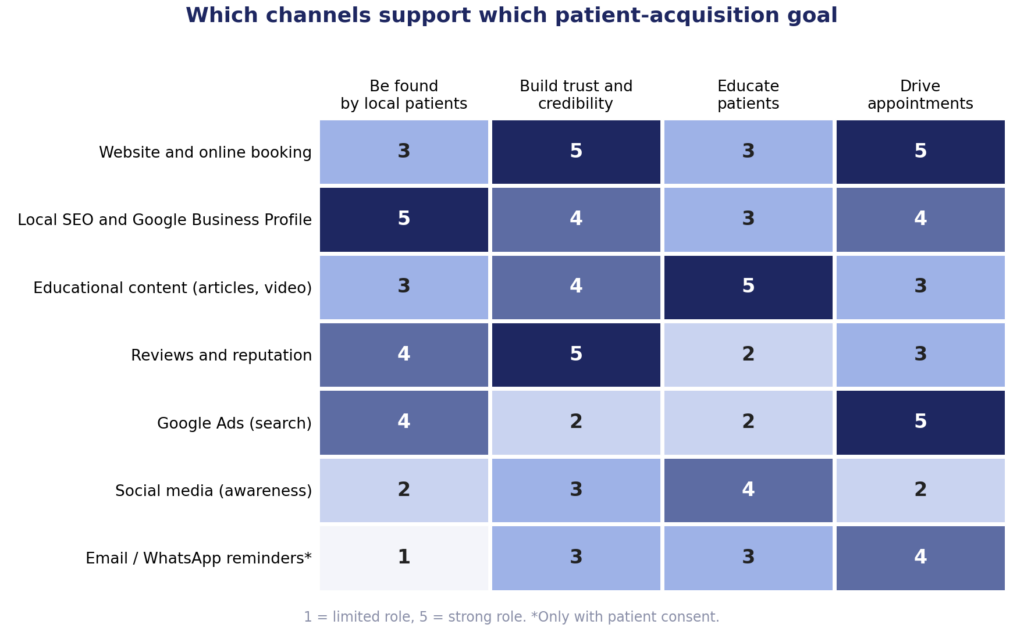
Different channels play different roles in the patient journey. The chart below summarises where each one typically contributes most, so you can match effort to your goals instead of spreading it thin
A Practical 90-Day Plan
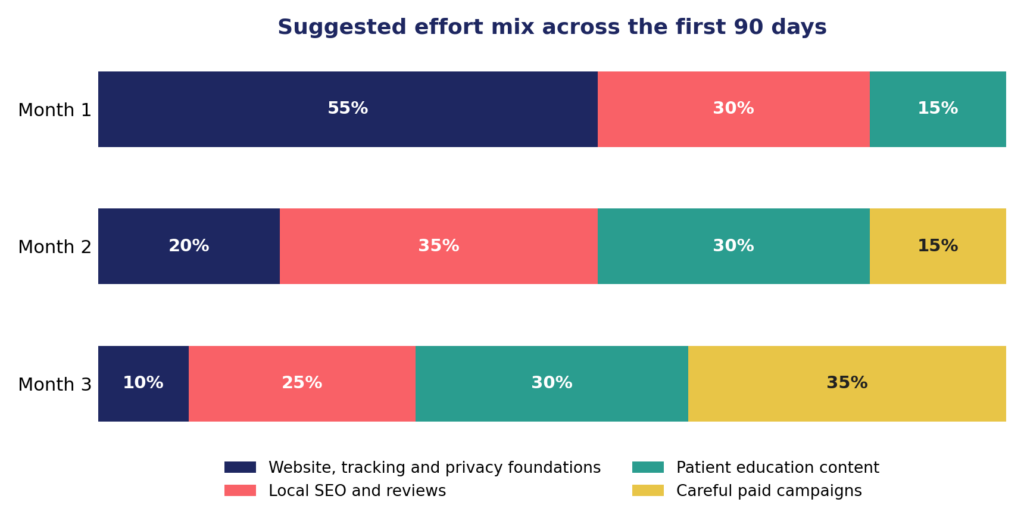
Healthcare marketing works best when the foundations come first. In the first month the priority is a trustworthy website, correct tracking and privacy safeguards, together with a complete Google Business Profile. Months two and three layer on local SEO, reviews and educational content, and only then add carefully managed paid campaigns.
Period | Focus |
Days 1-30 | Audit website, fix speed and mobile issues, set up secure booking and call tracking, complete Google Business Profile, review privacy settings |
Days 31-60 | Create department and doctor pages, publish first reviewed health articles, start a consent-based review programme, build directory listings |
Days 61-90 | Launch small, policy-compliant search campaigns, begin educational social content, review results and refine |
What to Measure
Follower counts and page views say little about whether marketing is helping the practice. Focus on measures connected to patient care and sustainable growth:
Metric | Why It Matters |
Appointment requests and calls | The clearest sign that marketing is reaching patients who want care |
Cost per appointment (for paid campaigns) | Shows whether ad spend is sustainable |
Appointment-to-visit rate | Reveals whether the right patients are booking and attending |
Google Business Profile calls and directions | Measures local visibility and intent |
Review count and average rating | Reflects trust and supports local rankings |
Organic traffic to department pages | Shows whether content is reaching patients searching for specific care |
Common Mistakes to Avoid
- Making outcome claims or guarantees that cannot be supported
- Using patient photos, testimonials or case details without documented consent
- Copying medical content from other sites or using unreviewed, thin pages
- Installing tracking tools on patient portals or intake forms without thinking through privacy
- Replying to reviews in ways that confirm a patient relationship
- Running ads without checking current platform health policies
- Ignoring mobile experience, even though most patients search on their phones
Frequently Asked Questions
Can doctors advertise online?
It depends on the country and the professional body that governs the doctor. Many allow factual information such as qualifications, services and contact details, while restricting promotional claims, comparisons and solicitation. Check your regulator's current rules before publishing.
Is SEO or paid advertising better for a clinic?
They serve different purposes. Local SEO and reputation build lasting visibility, while search ads can bring appointments faster for specific services. Many practices start with local SEO and add small, compliant campaigns once their website and tracking are ready.
How should we respond to a negative review?
Respond politely and briefly, thank the reviewer for the feedback, and invite them to contact the clinic directly. Do not confirm they were a patient or discuss any details of their care.
Can we use patient testimonials?
Often yes, but only with clear written consent, and subject to your local advertising rules, which may limit or prohibit testimonials. Never publish identifiable details without permission.
How long does healthcare marketing take to work?
Paid campaigns can produce enquiries within weeks, while local SEO, content and reputation building usually take a few months to show steady results. Consistency matters more than speed
Getting Started
Healthcare is one of the industries ARP SoftTech supports, and a good first step is a review of your current website, local listings and tracking. You can compare SEO packages and PPC packages, read more guides on our blog, learn about the team on the About Us page, or get in touch to discuss a plan that respects both your patients and the rules of your profession
Conclusion
Ethical healthcare marketing is not a limitation; it is a strategy. Providers that explain their services honestly, publish reviewed information, protect patient privacy and respond to reviews with care build the kind of trust that no advertisement can buy. Start with a trustworthy website and a strong local presence, add helpful content and responsible advertising, measure what matters to patient care, and keep the rules of your profession in view at every step.
Note*
This article provides general information only and is not legal, medical or regulatory advice. Always check current rules with your regulator or legal counsel